
Understanding PADD Regions
PADDs are used throughout the petroleum industry to track fuel supply, demand, production, and movement across different parts of the country. While they may not be something every business considers when planning their fuel needs, understanding how these regions work can provide useful insight into the factors that influence fuel availability and pricing.
What Are PADD Regions?
PADD – Petroleum Administration for Defense Districts
These regions were originally established during World War II to help manage petroleum distribution across the nation. Today, these groups serve as an important tool for understanding the U.S. fuel market.
The U.S. Energy Information Administration (EIA) uses the five main PADD regions to help organize and analyze industry data. Each region represents a different part of the country with its own supply networks and refining infrastructure.
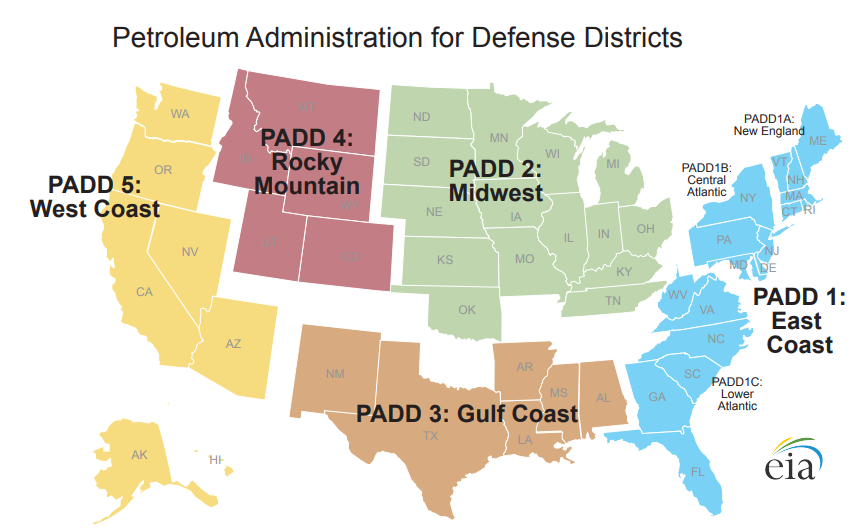
- PADD 1* – East Coast: Includes the northeastern and southeastern states along the Atlantic Coast
- PADD 2 – Midwest: Covers much of the central and north central United States, including Illinois, Ohio, Kansas, and Oklahoma
- PADD 3 – Gulf Coast: Includes Texas, Louisiana, Mississippi, Alabama, Arkansas, and New Mexico
- PADD 4 – Rocky Mountains: Covers Colorado, Utah, Wyoming, Montana, and Idaho
- PADD 5 – West Coast: Includes California, Oregon, Washington, Nevada, Arizona, Alaska, and Hawaii
*PADD 1 is further divided into three subregions to provide a more detailed look at fuel movement along the East Coast
Why Are PADD Regions Important?
Fuel does not move through the country as a single, connected market. Different regions rely on different combinations of refineries, pipelines, storage terminals, marine transport, and other distribution infrastructure. PADD regions help organize this information and provide a clearer picture of how regional fuel markets operate.
For businesses that depend on a consistent supply of diesel, gasoline, or other petroleum products, these market dynamics are important to understand.
How PADD Regions Affect Fuel Prices
Fuel pricing is influenced by several factors, and PADD regions help provide context for some of the regional differences businesses may see.
When fuel supply is readily available and distribution systems are operating normally, regional markets may experience relatively stable conditions. However, unexpected outages, pipeline disruptions or severe weather can affect the balance between supply and consumption.
When these changes occur, the impact can vary by region depending on available inventory, alternative supply sources, and local demand. It’s also important to understand that a PADD region does not have one single fuel price. Wholesale pricing can vary within a region based on the product, terminal location, transportation costs, and local market conditions.
PADD regions are not a tool for predicting every fuel price change. Instead, they provide a broader view of the petroleum market that can help businesses better understand the factors influencing their fuel supply.
What This Means for Your Business
While PADD data is often used by analysts, and fuel suppliers, it can also help businesses better understand the conditions affecting their fueling needs.
A few areas worth considering:
- Monitor fuel market trends. Understanding regional supply and demand can provide useful context when fuel prices change.
- Understand your local market. National and regional trends are useful, but local terminal pricing, transportation costs, and availability are also important when evaluating your fuel costs.
- Work with a knowledgeable fuel supplier. An experienced supplier can help interpret market conditions and determine what they may mean for your operation.
Let Us Help
We combine fuel industry expertise with tailored fueling solutions to help customers navigate changing market conditions and keep their operations moving.
Contact Us